

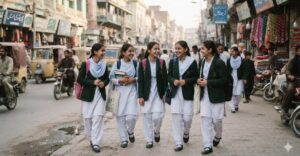
A child cannot learn well when a school has no dependable water, no usable washroom, or walls that leave her exposed to a busy road. A classroom may be open on paper while the conditions around it quietly push children away.
That is the lesson from a September 17, 2026 UNICEF account of a girls’ primary school in Lasbela District, Balochistan. The 2022 floods damaged the school and disrupted learning. Children studied in a temporary space while families waited for a place they could trust. Repairs later restored the water supply, fixed a tank and solar powered water motor, improved the building, and helped create a more private school boundary. UNICEF reports that enrollment at this school rose from 30 to 70 students.
Why a repaired school matters
It is easy to reduce education to books and lessons. Families have to consider more. Is the water safe and available? Can a girl use a washroom with dignity? Is the school protected from traffic and unwanted attention? Will a damaged building survive the next rain? These questions can decide whether a child attends regularly, especially when a household is already stretched by poverty or disaster.
The same UNICEF report says that 43 percent of primary school age children in Balochistan were enrolled at the appropriate level, compared with 68 percent nationally. Those figures describe a wide challenge, not a verdict on any child or parent. They show why getting children into a classroom requires attention to the conditions that keep them there.
There is also a hopeful lesson in what happened after the school repairs. Parents, teachers, and community members participated in the work. UNICEF reports improved attendance and greater confidence among girls. Enrollment rising from 30 to 70 at one school does not settle the province’s education crisis, but it shows how practical improvements can open a door that had been closing.
More than a single school
In a separate June 23, 2026 update, UNICEF said an education partnership with the Government of Balochistan and the European Union had expanded learning opportunities for more than 760,000 children over five years. Nearly 335,000 girls benefited, according to the agency. The program also supported teacher development, parent and teacher committees, and improvements in more than 1,200 schools.
Those numbers belong to that partnership, not to Global Freedom Mission. What they reveal is a principle that reaches far beyond one program: education lasts when families, schools, water, sanitation, and community support work together. A repaired classroom helps. A capable teacher helps. A parent who believes a child will be safe at school helps. Each piece matters.
Where GFM fits
Global Freedom Mission’s children and education work begins with the needs of the family and community in front of us. School supplies may matter. So may food, safe water, transportation, or support that lets a parent keep a child learning. We want our assistance to answer verified needs and to be honest about what it accomplishes.
As Christians, we believe every child is made with dignity and deserves a real chance to grow. Compassion should be practical. It should listen before it acts, work with local people, and stay long enough to ask whether the help made a difference.
If this story moves you, read the original UNICEF accounts and learn more about GFM’s education pathways and current clean-water assistance in Pakistan. You can also get involved or support GFM’s verified humanitarian work. The UNICEF school described above is not a GFM project. A child’s future is shaped by many decisions that adults make today. We can make better ones.
* Global Freedom Mission is not involved in the specific school or project described by UNICEF. We share this article to raise awareness and do our best to verify the accuracy of news and sources before posting. Sources: UNICEF, September 17, 2026; UNICEF, June 23, 2026.